
I’ve always wanted to be a writer. As a teenager and young adult I outlined and began writing several romance novels. I never finished any of them. More recently, I outlined and started collecting material for a book on dating after divorce. I didn’t finish that either. Given the long Facebook posts I was writing at the beginning of the COVID pandemic, it seemed like a good time to start a blog. I figured that since blog posts were short, I might actually be able to finish them. At first I had no problem following through, but blogging quickly became a source of stress, and I started to have the same feeling of dread when I thought about working on a blog post as when I think about writing a scientific manuscript for work.
The problem
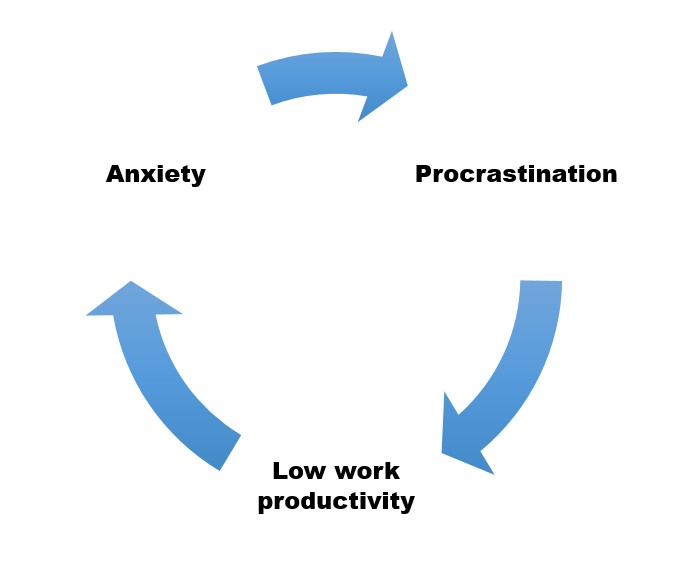
As a professor I am expected to write a lot – you know, publish or perish and all that. Therefore this writing dread is problematic. The truth is that I dread it because it causes significant anxiety. Therefore, when faced with a writing task, I procrastinate. I am a very accomplished procrastinator. If there were a Nobel Prize for procrastination, I’m pretty sure I’d be on the short list for it. Procrastination – particularly around writing – has become a major problem for me and has slowed my career progress. This makes me more anxious about writing (or more accurately, not writing), so I write less and less, creating a nasty feedback loop. The biggest reason I feel anxious about writing is fear of being judged harshly. I don’t want to be judged at all (unless it’s a favorable judgement, of course). In case you haven’t already guessed this: I am a perfectionist. I was brought up to be one. In my memory, at least, the expectation of perfection wasn’t just implied, it was explicit. No one ever had anything good to say about anything – only criticism. Consequently, I the imperfections in everything I do are always painfully obvious to me, and I’m sure that others will see these imperfections, too. I’m sure they will find new ones I didn’t notice, which is even worse.
My fear of imperfection falls along two lines. The first is related to form. I’m mostly concerned about grammar, but organization is also a frequent source of indecision. I am very worried about whether I have organized my writing in such a way as to make the make the most effective argument. The second issue is content – specifically, whether the statements I have made are factually correct.
Form
My sister has a mug that says “I’m silently correcting your grammar,” and it’s true, she really is silently correcting your grammar. So am I. Unless you are a family member – or someone on the TV or radio – in which case I’m correcting you out loud. This is not to say that my speech and writing are always grammatically correct (or well-organized, etc.). I know they aren’t, and I worry all the time that someone will catch me saying or writing something that contains an error. I worry about it so much that I’ve come to have long pauses in my speech while I search for just the right word or turn of phrase. My sister and I got this concern about English grammar and usage from her mother, who is my step-mother. My step-mother knows grammar better than anyone I’ve ever met. I operate more from the perspective of what does and doesn’t sound right. My step-mother actually knows the all the rules and terminology. She probably even remembers how to diagram sentences! If I’m writing something she will read – even a text – I will often re-write it numerous times until I’m as sure as I can be that it is right. Even then, I fear that she will find an error. So what if she does? Then I am sure she will think I’m either sloppy or unintelligent – or both.
Having a well-organized argument is also of concern for me. What if people aren’t convinced? What if people don’t understand what I’m trying to say? What if people think I’m stupid? These thoughts keep me revising everything I write, from comments on student assignments to texts and emails, to manuscripts and blog posts. If I know I’m going to revise everything up to a dozen times (sometimes more), no wonder writing anything seems like a daunting task!
Content
And then there is content, which is equally worrisome. (Full disclosure here: I’m not sure whether that last paragraph really belongs in that last section or this one.) At issue is that I might be wrong, just like with grammar. When writing a grant application or a scientific journal article, my main concern is with the need to demonstrate that I know everything there is to know about anything possibly related to the topic of my manuscript. This means that I need to find and at least read the abstracts and look at the tables/figures of everything I can find, decide how to accurately summarize what I have found, and then provide citations for my statements. I find this to be overwhelming. I fear I have missed something important and obvious that is already known and because of this people will think I don’t know what I’m doing – they will see that I am an imposter. Therefore, I spend an inordinate amount of time on literature review, and I’m never sure I’m done. All of this makes writing unpleasant, and so I avoid it. This is one of the reasons why my works in progress remain perpetually in progress and I haven’t written a grant proposal in years.
How does this all relate to writing blog posts?
I imagine the answer to this is somewhat obvious by now. Not only am I worried about grammar and organization, I’m also often writing about scientific topics and making statements that require citations – the name of this blog is “The evidence suggests…” , after all. If writing blog posts is as onerous as writing scientific journal articles and grant proposals, then I procrastinate about finishing the blog posts as much as I do about finishing my writing for work. I think I have about 10 half-written blog posts, which is similar to the number of incomplete manuscripts that I need to finish up and submit to scientific journals. If you are a colleague of mine, you are probably a co-author on a manuscript I have yet to complete. This brings me to the second thing that has been holding me back: if you are a co-author on one of these manuscripts, I assume you think I shouldn’t be writing blog posts. I’m sure you are thinking “What the f*** is she doing blogging? If she has time to write blog posts, she has time to finish that god-damned manuscript!” This makes sense, and since my last blog post was over a year ago, one would think I’ve since submitted all of those manuscripts, right? Not a chance.
What’s the solution?
Given the anxiety and self-esteem issues evidenced above, you’ll be relieved to know that I have a therapist. I’m working with said therapist on my anxiety and perfectionism. I’m sure I’ll write more on that in the future. Anxiety and perfectionism are keeping me from finishing those manuscripts for work, too, so perhaps if I break through the writing barrier with one type of writing it will transfer to the other. For now it occurs to me that perhaps I might feel better about letting other people read things I’ve written if I were to manage the reader’s expectations with a disclaimer. Here it is:
DISCLAIMER: The author acknowledges that the writing in this blog will not be perfect. There will always be room for improvement. Furthermore, the author is not all-knowing and therefore may at times say things that she later finds to be inaccurate. When this happens, the author promises to correct these inaccuracies as soon as she becomes aware of them.
Is this a good ending or do I need some sort of concluding paragraph? I can’t decide. I also probably ought to find some sort of image. I’m just going to post this anyway.
The End
Leave a Reply